
Introduction
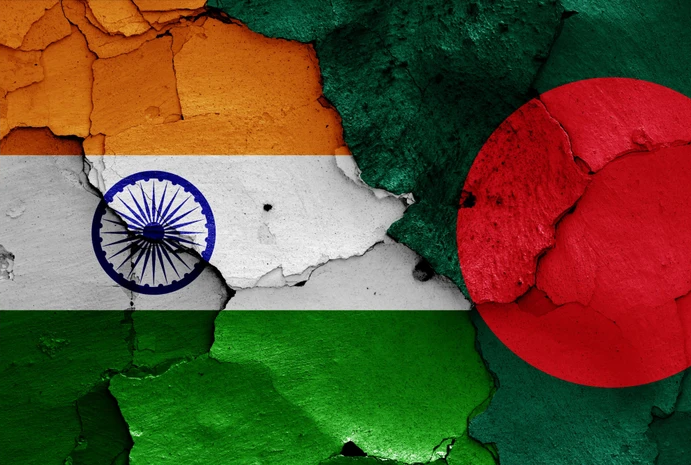
India-Bangladesh relations have witnessed periods of bonhomie and tensions since latter’s liberation from Pakistan in 1971 during which it had received unconditional political, diplomatic and military support from India. Since its independence, depending on the domestic political dispensation, Dhaka has viewed New Delhi from different prisms of a friendly neighbour at one end of the spectrum, to suspicion, disdain, an overbearing neighbour, and at times a bully.
Triggers of Current India Bangladesh Tensions.
India-Bangladesh relations were perhaps at their best under Prime Minister Sheikh Hasina’s dispensation (2009–2024) and were marked by high level visits, settlement of maritime and land boundary disputes, trade and investment deals, land-river-rail connectivity projects, energy grids, etc. However, since July-August 2024, domestic political developments in Bangladesh involving student protests over reform of a ‘quota system’ for jobs, earlier scrapped in 2018, led to wide spread demonstrations across the country. Prime Minister Sheikh Hasina’s government undertook a major crackdown in which, according to U.N. human rights office, up to 1,400 people may have been killed.
Prime Minister Hasina was forced to step down; she fled to India and sought refuge. Subsequently, Bangladesh’s International Crimes Tribunal tried Hasina and her co-accused former home minister Asaduzzaman Khan in absentia, and convicted both of “crimes against humanity” and ordered death penalty.
The underlying issues of current discord between Bangladesh and India and stem from former Prime Minister Sheikh Hasina’s continued asylum in India amid extradition demands from Bangladesh’s interim government, and attacks on minority Hindus in Bangladesh who now live in fear and insecurity, respectively.
India Government’s Consideration on India-Bangladesh Relation
Diplomatic interactions between India and Bangladesh after Prime Minister Sheikh Hasina’s exit from the country in August 2024 have continued. Both sides have shared respective grievances and concerns and have kept communication channels of open.
In December 2024, Foreign Secretary Vikram Misri called on Chief Advisor Muhammad Yunus. Yunus raised concerns over provocative statements being made by Sheikh Hasina and cautioned that these were not on the interest of both countries. Later, in his interaction with media, Misri stated that New Delhi’s was committed to engage the interim government.
Prime Minister Narendra Modi and Chief Advisor Muhammad Yunus met on the sidelines of 6th BIMSTEC summit in Bangkok in April 2025. Modi assured Yunus of India’s continued “support for a democratic, stable, peaceful, progressive and inclusive Bangladesh. Modi emphasised on the “safety and security of minorities in Bangladesh, including Hindus” and conveyed his “expectation” that these should be “thoroughly investigated”.
However, Chief Advisor Muhammad Yunus’s politico-diplomatic-strategic choices have soured bilateral ties. First, Yunus chose to visit China instead of India for his first official visit, a departure from the long-standing practice by the earlier Bangladeshi Heads of State, barring President Zia ur Rahman who too had chosen China for his first official visit. This is notwithstanding Prime Minister Modi was the first leader to greet Muhammad Yunus on assumption of office as the Chief Adviser of Bangladesh.
Second, while in China, Muhammad Yunus made reference to India’s northeastern states (collectively referred to as Seven Sisters) characterizing them as landlocked and without “access to the ocean. We [Bangladesh] are the only guardians of the ocean in this region. This opens up huge possibilities,” Furthermore, “Bangladesh could be an extension of the Chinese economy—building, producing, and marketing goods for China and the world.” New Delhi was visibly irked and reproached him of ostensibly supporting Chinese claims over Arunachal Pradesh, one of the ‘Seven Sisters’. According to media reports, India “demanded a retraction” of Yunus’s statement.
Third is the revival of bilateral relations with Pakistan that were at their lowest during Sheikh Hasina’s regime ostensibly at the best of India. The arrival of Muhammad Yunus at the helm of affairs was an opportune moment to reset the relationship and Islamabad made quick overtures to Dhaka. Since 2024 both countries have reset ties marked by ministerial and high-level military contacts, and trade and economic cooperation.
Recent participation by high level Pakistani political leadership at the funeral of former Prime Minister Begum Khaleda Zia was symbolic and significant indictor of the positive changes in bilateral relations. Also, shipping services between Karachi and Chittagong ports have begun, and flights between Dhaka and Karachi will commence from 29 January 2026; it is not known if New Delhi has accorded clearance to these flights to use Indian airspace.
Fourth is the interim government decision to refurbish a World War II era air base under the control of the Bangladesh Air Force. Located close to Indian border, the Lalmonirhat air base is barely 135 kilometers from the Siliguri Corridor also referred to as ‘Chiken’s neck’ and connects the country with its northeastern states. The air base had been inactive for decades and its revival is seen as India’s strategic vulnerability allowing Bangladesh Air Force to maintain continuous watch over Indian Army’s movements and operations, as well as intelligence gathering that could be shared with China. Although the revival of the Lalmonirhat air base has been dubbed as up gradation of a civilian project, it is seen in India as potentially dual-use aviation infrastructure.
Apparently, Chinese officials and a Pakistani firm may have visited the site which is potentially a major geopolitical flashpoint and attracts complex security challenges confronting India’s eastern theatre particularly against China which has now upgraded several airports/bases in the Tibet region and deployed military aircraft. Perhaps what may have also caused suspicion among Indian military circles about the revival of Lalmonirhat air base is the timing of the project i.e. just weeks after India’s Operation Sindoor that was launched in response to Pahalgam terror attack.
Potential Shifts in India’s Diplomacy Strategies towards Bangladesh
New Delhi has so far remained neutral over domestic political developments in Bangladesh. Prime Minister Modi had assured Muhammad Yunus of India’s “people-centric approach to the relationship” and expressed his country’s desire to “forge a positive and constructive relationship with Bangladesh based on pragmatism”. In his statement before the Indian parliament, India’s Foreign Minister Dr. S. Jaishankar made known that India was in touch with “various political forces” in Bangladesh and had “repeatedly counselled restraint” and had “urged that the situation be defused through dialogue”.
Cross-border power supply arrangement under Indo-Bangladesh energy partnership continues unhindered. Bangladesh imports nearly 20% of its power from India. It had owed Indian power companies over US$ 1 billion of which US $800 million were to be paid to Adani Power. The Bangladesh Power Development Board (BPDB) had expressed inability to settle bills due to “costly fuel and goods imports since the 2022 war in Ukraine”. In December 2024, Adani Power, announced curtailment of electricity supply to Bangladesh over outstanding payment, but the Bangladesh government cleared in June 2025 and is seen as a step forward in the otherwise tenuous bilateral relations.
However, India did take light retributive action. It revoked the 2020 transshipment agreement that allowed Bangladeshi goods to move through Indian Territory to airports and ports en route to Nepal, Bhutan, and Myanmar citing “logistical delays and higher costs were hindering our own exports and creating backlogs”
Implications of the Upcoming Bangladesh Elections and Possible Outcomes
Bangladesh is preparing to hold general election on 12 February including a referendum over “July Charter and its associated constitutional amendments regarding executive authority, judicial independence, the autonomy of the Election Commission, and law enforcement agencies”.
The leading contenders are Shafiqur Rahman representing Jamaat-e-Islami (JeI), Tarique Rahman of the Bangladesh Nationalist Party (BNP), and G M Quader of the Jatiya Party. The registration of the Awami League (AL), which wanted to contest for its third term, has been rejected by the Election Commission after the interim government of Muhammad Yunus banned its activities. Sheikh Hasina has questioned the interim government and the Election Commission over legitimacy of the elections, and lamented that “election without the Awami League is not an election, it is a coronation,”
Be that as it may, there is skepticism as well as optimism in New Delhi over the outcome of the elections amid fears that the new dispensation in Dhaka may or may not be favourable towards India. Anti-India sentiments cut across party lines and there is widespread angst among the Bangladeshi populace against India for not extraditing Sheikh Hasina and Asaduzzaman Khan Kamal, both accused of 2024 crackdown against the student uprising and facing death penalty in Bangladesh.
The killing of Sharif Osman Hadi, a prominent Bangladeshi student activist, is allegedly linked to India which Sheikh Hasina has now dismissed as “manufactured narrative” and “driven by fundamentalist forces that thrive on hostility toward Bangladesh’s closest ally and seek to recast internal governance failures as foreign conspiracies,”
The Indian Ministry of External Affairs lodged a formal diplomatic protest with Bangladesh High Commissioner to India that some extremist elements in Bangladesh had drawn plans to surround the Indian mission in Dhaka and create a “security situation”. The protest also included concerns over anti-India statements by Hasnat Abdullah, the leader of National Citizen Party (NCP) threatening that India’s northeastern “will be separated from India,”
India’s apprehensions also arise from the religion-driven domestic sentiments against Hindus. The lynching and setting on fire a Hindu man over allegations of blasphemy, have unnerved India. According to Bangladesh Hindu Buddhist Christian Unity Council as many as 51 incidents of communal violence were recorded in December 2025.
The successive governments in Bangladesh have conducted elections since first general election in 1973 and thereafter in 1979, 1985, 1988, 1991, 1996, 2001, 2008, 2014, 2018 and 2024. It is fair to assume that “electoral violence, political interference, misuse of state resources, money politics, vote suppression, and violence—particularly against minorities”, a feature in earlier elections, may create disruptions/disappointments.
The Indian Ministry External Affairs has emphatically stated that “as a close neighbour, India remains committed to the best interests of the people of Bangladesh, including in peace, democracy, inclusion and stability in that country,” and is willing to “engage constructively with all stakeholders to that end.”
New Delhi is hopeful of reset in ties with Khaleda’s Bangladesh Nationalist Party (BNP) which is now led by her son Tarique Rahman. It is true that the BNP and its earlier alliance partner Jamaat-e-Islami, had advocated strong ties with Pakistan to balance Sheikh Hasina closeness to India; however, a “very cordial” meeting between India Foreign Minister and Rahman in Dhaka is seen as “potential of a new phase in the bilateral relationship”, Similar sentiments have been expressed by Bangladeshi Adviser of Foreign Affairs Md Touhid Hossain who observed that bilateral relations are not “cold”; instead are in “readjustment phase” and his country is “open to engaging” India.